
Boston Heartbreakers: 5 Times Beantown Sports Legends Left for Rivals

Despite the success, Boston sports fans have dealt with a ton of heartbreak in the form of player defections.
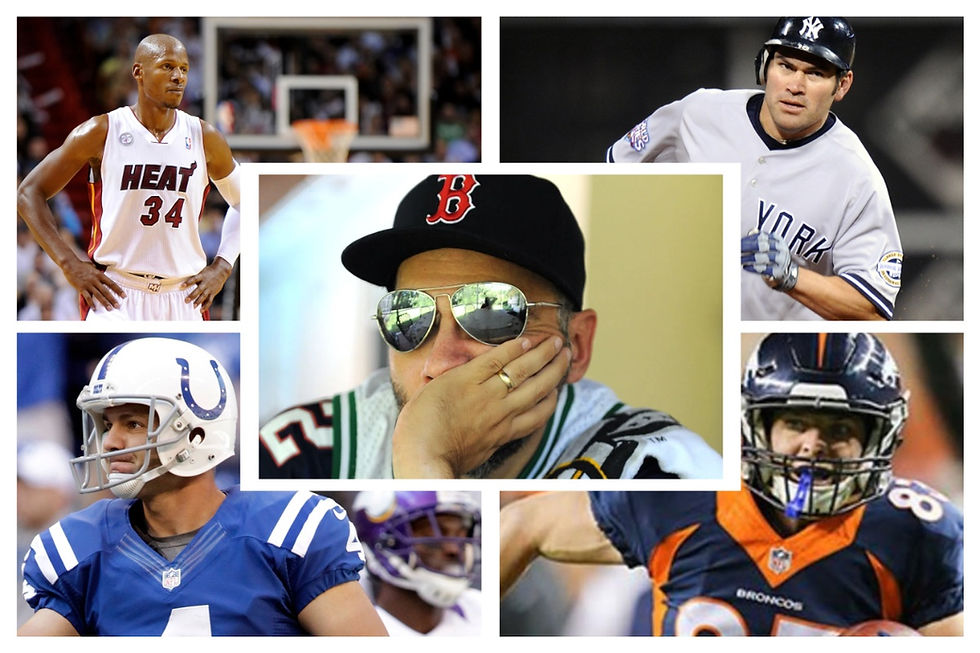
Breaking up is hard to do. It’s even harder when your former love leaves you for one of your rivals. Imagine how Zack Morris, the preppy King of Bayside, felt when every boy’s dream girl, Kelly Kapowski, cut ties with him to be with the muscle-bound, jocktastic A.C. Slater. After cruising through high school, his life came to a screeching halt, and suddenly, he shared the same sense of despair and loneliness as Screech.
For Boston sports fans, that feeling is all too familiar. Sure, we’ve been spoiled with Duck Boats parading down Boylston almost as often as the groundhog sees his shadow. But we’ve also endured devastating heartbreak - often delivered by our once-beloved heroes trading in their Beantown unis for the threads of a hated rival.
It’s a tale as old as time, and it’s happened more often than we’d care to admit. So with that in mind, let’s break down the five most devastating defections in Boston sports history.
Ray Allen joins the Heat

As a millennial, my earliest Celtics memories were Antoine Walker jacking up nine threes a game (because sadly, there were no four-pointers) and Paul Pierce occasionally willing a sparse roster to victory. After decades as the NBA’s premier franchise, these were the Dark Ages of Celtics basketball.
All that changed in the summer of 2007 when the Celtics acquired Ray Allen, then traded a bag of Doritos, three Slinkies, and a Snuggie for Kevin Garnett. Joining forces with Pierce, the “Big 3” meshed instantly, storming out to a 29–3 start and ultimately raising Banner 17 in 2008.
Unfortunately, the championship window was smaller than expected. KG’s injury derailed the 2009 run, and a brutal Game 7 loss to the Lakers in the 2010 Finals left the group running on fumes. To make matters worse, a shinier, younger “Big 3” was assembled in Miami - LeBron, Wade, and Bosh - setting the stage for an instant rivalry.
After ousting Boston but losing to an inferior Dallas team in the Finals, the Heat were determined to grab a Larry O’Brien trophy in 2011-2012. Boston had other ideas. As fate would have it, they matched up again in the playoffs, and against everyone’s expectations, Boston led the series 3-2, pushing Miami to the brink of elimination.
Then came Game 6. Bron’s extraterrestrial masterpiece - 45 points on 19-26 shooting, 15 rebounds, and 5 assists - silenced the Garden. Miami sealed it in Game 7 and went on to win the title.
Off to South Beach
And then, the unthinkable. The Celtics’ smooth-shooting, gum-chewing, clutch 2-guard known to TD Garden fans as “Ray Ray” bolted for South Beach. It was painful enough to lose a core piece of the Big 3, but to see him join them – the rivals who had just shattered our dreams - was almost unbearable.
The C’s picked up the pieces and tried to convince fans that Allen’s replacement, Jason Terry, would fill in admirably for their lost star. That idea aged about as well as the trophy-hoisting Lucky the Leprechaun tattoo Terry got inked on him shortly after inking his deal.
Sweet Baby Ray proved that he still had the sauce in Miami, splashing in one of the most clutch three-pointers in NBA history to save Game 6 of the Finals for the Heat and help deliver back-to-back titles in his first season with the team. Many credit that shot with saving LeBron’s legacy. For Celtics fans, it was another punch to the gut.
Still, time heals. Despite years of bitterness, the Big 3 reconciled at KG’s jersey retirement in 2022, proving that the ubuntu spirit is everlasting.
Adam Vinatieri heads to Indy
For years, the debate over who deserved the most credit for the Patriots’ dynasty centered on Tom Brady and Bill Belichick. After Brady’s late-career renaissance in Tampa, many Belichick backers have softened their stance. Often overlooked in these conversations - because kickers rarely get their flowers - is the great Adam Vinatieri.
In 1996, the Patriots changed the trajectory of their franchise with a remarkable draft class that included Tedy Bruschi, Lawyer Milloy, and Terry Glenn (remember when the Pats could evaluate talent?). Not to be overshadowed was Adam Vinatieri, who arrived as an undrafted free agent and quickly claimed the starting kicker job.
When Grandpa Simpson sits on the hill to tell the story about the Patriots' dynasty, he usually starts with the Snow Bowl against the Raiders in the 2001 AFC Divisional Playoff game - that is, if he doesn’t lose track of what he was saying.
On January 19, 2002, as snow quietly blanketed Foxboro Stadium, the Patriots played their final game there – and made it one for the ages. Some remember Jermaine Wiggins, the local legend, sliding around in his Iverson cleats while hauling in ten catches; others point to a controversial call best left unmentioned. But in the end, it was Adam Vinatieri who stole the show.
With less than a minute left in regulation, he drilled an impossible 45-yarder through the blizzard to tie the score at 13 and send the game into overtime. He then banged home a 23-yarder in OT, cementing himself as Mr. Clutch. The Raiders still haven’t thawed out from their cold streak.
Vinatieri wasn’t done. Against the heavily favored St. Louis Rams, he connected on a 48-yard bomb as time expired in Super Bowl XXXVI to give the Patriots their first Super Bowl victory and kickstart (pun intended) the greatest dynasty in sports history.
Two years later, in Super Bowl XXXVIII, Vinatieri hit another buzzer-beater, this time a 41-yard strike against the Panthers.
His meteoric rise brought plenty of endorsement deals, the most iconic being his Papa Gino’s commercials that lit up New England TV screens in the Fall. This was a big deal, because back then, Papa G’s pizza slapped almost as hard as Vinatieri kicked.
Throughout the Patriots’ first half of their dynasty, the Indianapolis Colts - led by their five-star, five-headed QB Peyton Manning - played the role of arch nemesis. Early on, the rivalry was lopsided in New England’s favor. Despite both teams peaking in the early 2000s, the Brady and Belichick-led Pats defeated Indy six times in a row.
To Indy Goes Vinny
The tide turned after the 2005 season. Coincidentally or not, that was the very offseason Vinatieri signed with the Colts. After the Pats decided against putting their franchise tag on him as they had the previous year, Vinatieri tested the market and chose to try his luck with the blue horseshoes.
He found instant success with his new squad, helping Indy topple the Patriots in their regular season meeting at Gillette to claim home field advantage, and then again in the 2006 AFC Championship en route to winning Super Bowl XLI. That AFC Championship loss still haunts New England, as the Pats had led by 18 points. For fans, it suddenly became clear why Eve handed Adam the infamous apple.
Years later, Vinatieri explained that his choice to leave New England was a business decision, and he simply wanted to be paid what he was worth. Through it all, he lives on as a Patriots legend and was recently announced as a finalist for the team’s Hall of Fame class of 2025. Papa Gino’s, on the other hand, has never fully recovered.
Johnny Damon to the Yanks

The Red Sox were founded in 1901, their name inspired by the National League’s Boston Red Stockings. Apparently, red undergarments were all the rage back then.
Early on, they were a powerhouse, winning five World Series titles between 1903 – 1918, and knocking the socks (and stockings) off their fans. But everything changed in 1920, when the Sox sold Babe Ruth to the Yankees. New York became a juggernaut, while Boston entered an 86-year championship drought named after the Babe, called “The Curse of the Bambino.”
By the early 2000s, the Sox finally looked ready to reverse the curse. Their team of fun-loving perennial underdogs, led by Pedro Martinez, David Ortiz, and Manny Ramirez, was the antithesis of the straight-edge, hyper-successful baseball robots in New York.
Nobody embodied the spirit of the Sox as much as their leadoff hitter, Johnny Damon. After signing with the team in 2002, he quickly surpassed Matt as the most famous Damon in town. Sorry, Matt - it’s not your fault.
With his shaggy hair, flowing beard, and hard-nosed playing style, Damon quickly stole the hearts of fans in Boston almost as quickly as he stole bases. He earned the nickname “The Caveman” and was revered as a Christ-like figure for his appearance and role as savior to the team.
After the gut-wrenching 2003 ALCS loss to the Yankees, the 2004 Sox were a team on a mission. As fate would have it, they matched up with the Yanks the next season in the ALCS. Both teams had retooled in the offseason, with New York’s big offseason prize being Alex Rodriguez - emphasis on the word tool.
New York won the first three games of the hotly contested series, including a 19-8 spanking in Game 3. A miraculous comeback victory by the Sox in Game 4 changed the trajectory of the series and eventually gave the self-proclaimed “idiots” a chance at redemption in game 7.
The Sox heroically dismantled the Evil Empire in the series finale, with Johnny Damon’s two homers (including a grand slam) doing most of the damage. This patchwork team of misfits had done the unthinkable and were on their way to fulfilling destiny, sweeping the Cardinals in the World Series and capturing their first title in 86 years.
All was well with the world - until it wasn’t.
To the Evil Empire
In December 2005, Damon shocked all of New England by signing with the detested Yankees.
How could Jesus betray us like this? When I first heard the news, I almost spit out my communion wine - and I wasn’t even drinking any.
The free-spirited Tarzan, who had been swinging his branch at the top of the Sox lineup, shaved his beard, cut his hair, and strolled into Yankee Stadium wearing pinstripes in 2006, much to the chagrin of Red Sox nation.
Joining the corporate machine that is the Yankees, and opting to bat leadoff ahead of Jeter, A-Rod, and Giambi, while raking in $52 million on a four-year deal, officially ended the love affair the city of Boston had with its Head Idiot.
What made it worse? The year before, he had sworn, "There's no way I can go play for the Yankees, but I know they're going to come after me hard.” Ouch.
Damon went on to play four solid seasons in the Bronx, winning the 2009 World Series. Though his departure stung, Boston’s three titles since his exit have helped ease the pain.
When Damon returned to Fenway in 2024 for the 20th anniversary of the ‘04 champs, he finally felt the love from Sox nation that he had been missing. With his hair grown out long, it felt like he was back where he belonged, and for that night, Christ had risen.
Wes Welker heads out West

While the early 2000s Patriots are often remembered as complete teams with stout defenses and efficient, if unspectacular, offenses, the same can’t be said for the dynasty’s second act.
By the 2007-2008 season, Tom Brady had fully ascended the mountain of all-time great quarterbacks and, to no one’s surprise, began to look downright GOAT-like.
Before Bill Belichick started scouting local high schools for a girlfriend, he was a master at finding overlooked or undervalued talent and turning them into studs. That knack was on full display that historic season.
Everyone remembers Brady’s electric connection with Randy Moss, but it was a pint-sized slot receiver named Wes Welker who was the true engine of the Patriots' offensive juggernaut, one that began torching the league on an annual basis.
After Welker lit up New England as a Dolphin in ‘06, both as a receiver and return man, Belichick made it his mission to bring him to Foxborough. In one of the most lopsided trades of his reign, BB sent 2007 second and seventh-round picks to Miami for the 5’9 receiver - a move that would revolutionize his offense.
During their historic 16-0 regular season, the Patriots set multiple offensive records, including single-season marks for total points (589) and Brady’s then-record 50 touchdown passes. Their offense thrived on quick strikes to Welker underneath and deep bombs to Moss that spread the field, created mismatches, and wreaked havoc on defenses all season.
In fact, they scored so many touchdowns that year that there was a national shortage of musket ammunition from all the celebratory shots fired by their End Zone Militia.
After defeating the Giants in the final game of the regular season to cap their perfect run, the Pats faced them again in Super Bowl XLII as heavy favorites. In a shocking twist, the Giants stunned everyone (including themselves) by taking down New England 17-14 and spoiling what could have been the greatest season in NFL history. Eli Manning’s perpetually confused facial expression suddenly made perfect sense.
Despite falling short of perfection, a new record was quietly set across offices in New England: the most sick days taken in a single week, as Pats fans collectively mourned what might have been.
By 2012, the Patriots were primed for revenge, set to clash with the G-Men again in Super Bowl XLVI. Once more, the Patriots entered the game as favorites - and once more, they were overpowered.
The game was eerily similar to the previous Super Bowl matchup: low-scoring, tight throughout, and destined for heartbreak. After New York jumped out to a 9-0 lead, New England answered with 17 straight points to take control.
Holding a 17-15 lead late in the fourth quarter, the Pats had a chance to seal the game…until that play happened. On third down, Brady threw slightly behind and high to Welker, forcing him to twist midair and reach back with both hands. Unlike the 118 times he hauled in a pass during the regular season, this one slipped through his fingers.
The Giants lived up to their name and marched down the field for a huge scoring drive, snatching yet another Lombardi from New England’s grasp.
Famously, after the game, Brady’s then-wife, Giselle Bundchen, was caught shouting, “My husband cannot f****** throw the ball and catch the ball at the same time!” - a not-so-subtle low blow to the diminutive Welker.
Ironically, Tommy would later get his chance to catch the ball in Super Bowl LII, six years later - and, well, we all remember how that turned out.
Welker played one final season with the Pats, ending disappointingly with a 28-13 loss to the Ravens in the AFC Championship.
Joining Peyton
In the galactic war of NFL stars during this era, Peyton Manning was still playing Darth Vader to Brady’s Luke Skywalker. Manning led a Mile High offensive powerhouse in Denver that proved too enticing for Welker to pass up as he headed into free agency in 2013.
Welker’s departure to the Patriots’ AFC rival was especially tough for Brady to stomach, given he had just restructured his contract to free up space. A source close to the quarterback said he was “bummed out” by the move, which, for Brady, is the emotional equivalent of weeping uncontrollably.
Despite getting so close to the league’s mountaintop, Welker decided a hike to the Rockies was his next best move.
The decision paid off quickly. He and Denver’s high-powered offense tormented the league in his first season with the squad. The Broncos went 13-3, setting NFL records for total points (606) and points per game (37.9). It was the most torrid pace anyone had seen from a Bronco since OJ’s highway chase.
Lo and behold, Denver would go on to face New England in that year’s AFC Championship. To no one’s surprise, Welker played a pivotal role in determining the game’s outcome - though not in the way anyone expected.
Early in the second quarter, Welker collided with the Pats’ star cornerback Aqib Talib in a “pick play,” knocking him out of the contest and giving the Broncos free rein with their passing attack.
They went on to dominate, punting only once and cruising to a 26-16 win.
Bill Belichick didn’t mince words afterward, calling Welker’s hit “one of the worst plays I’ve ever seen.”
It didn’t do much to improve the receiver’s reputation among New England fans who already held a grudge, both for the drop and for leaving town to join the Broncos.
While Welker managed to reach his third Super Bowl, he whiffed once again, striking out on his final chance at a ring.
The Patriots, meanwhile, went on to win three more titles after his departure and found another undersized slot receiver in Julian Edelman, who not only erased the bitterness fans felt towards Welker, but also outshined him. Instead of being known for a crushing drop, Edelman became famous for perhaps the most clutch catch in Super Bowl history.
Despite his historically productive six-year tenure with the Pats, New England’s feelings towards the star receiver remain complex - a mix of admiration, frustration, and what-ifs. It turns out, leaving New England for Denver was like leaving Dunkin’s for Starbucks: it might look fancier, but it just doesn’t hit the same.
Sparky Lyle saves his best for the Yanks

When I first decided to create this list, I came up with a set of loose requirements for who should make the cut:
The player had a major impact on a Boston sports team.
The player joined a hated rival team at the height of their powers, and immediately after leaving Boston.
They weren’t traded – they chose to walk away.
With these rules in place, players like Roger Clemens (who stopped in Toronto before donning pinstripes) and Rajon Rondo (who bounced around the league before signing with the Lakers) were disqualified.
The first four picks came easily, as I lived through their exits and still remember the sting.
The fifth and final selection gave me trouble.
Recently, while taking out the trash, I ran into my elderly, good-natured neighbor, Bob, and told him about the article's premise, along with the dilemma I faced in filling the last spot.
Without hesitation, Bob looked me dead in the eye and growled, “Sparky Lyle.”
The sky darkened. Thunder cracked. Bob’s jaw clenched, and years - no, decades- of pent-up Red Sox resentment finally erupted.
“The Sox gave him a shot in the Big Leagues,” he barked. “Then what does he do? He leaves us for the damn Yankees - and helps them dominate! Screw him!”
It’s been a few years, 53 to be exact, since that transpired, so I’ll cut Bob some slack. Lyle didn’t sign with the Yankees; he was traded to them in one of the most lopsided deals in Red Sox history.
Boston drafted Lyle in 1964. He worked his way up the farm system, making stops in Winston-Salem, Pittsfield, and Toronto before reaching the majors.
Much like Harold and Kumar on their quest for White Castle, it wasn’t until Lyle found his slider that he finally reached his goal - major league success.
Ted Williams introduced the pitch to him and said it was “the best pitch in baseball” because he couldn’t hit it, even when he knew it was coming.
Lyle used the pitch to become Boston’s go-to bullpen arm, posting a 22-17 record, 69 saves, and a sweltering 2.85 ERA during his five seasons with the team.
Not only did he become one of the founding fathers of the closer role, but he also revolutionized the way teams began using their bullpens.
Then came the trade.
Lyle for Cater
After the 1971 season, the Yankees needed a closer and struck a deal with Boston. They sent aging first baseman Danny Cater to the Sox in exchange for Lyle.
Cater, as it turns out, would never quite cater to the team’s needs. He hit a pedestrian .262 with just 14 home runs in three uneventful seasons with the Sox.
Sparky, on the other hand, had his fuse lit in New York.
From 1972 to 1978, Lyle cemented himself as the ace of the Yankees’ bullpen. In 1972, he notched a then-record 35 saves for a left-handed reliever and finished third in MVP voting.
His masterpiece came in 1977: a 13-5 record, 26 saves, 2.17 ERA, and the first American League Cy Young ever won by a relief pitcher.
By that time, Cater had already retired - likely watching from a recliner, bathed in the soft glow of a lava lamp with a lukewarm fondue plate on the coffee table.
Lyle would go on to help lead the Yankees to back-to-back World Series titles in 1977 and 1978 - the very years the Sox were melting down, most notably during the infamous collapse of ’78. That year, Boston held a 14-game lead in July before being swept by the Yankees in a pivotal four-game September series. Both teams finished the season with 99 wins and met for a one-game playoff, in which Bucky Dent’s soul-crushing homer sent New York to the postseason.
Trading a future Cy Young winner for a marginal player became symbolic of Boston’s mismanagement - and left a bad taste in the mouths of fans across New England.
Years later, it came out that Lyle - a well-known clubhouse prankster - was famous for sneaking into the locker room during games and sitting naked on his teammates’ birthday cakes, leaving the imprint of his backside on the frosting. Sadly, this isn’t a joke.
Maybe the Sox cared more about keeping their birthday cakes safe from Lyle’s cakes than they did about winning?
Whatever the case, this one’s for you, Bob - and the Sparky Lyle dartboard you have hanging in your living room.


These instances truly highlight the emotional aspect of athletics, where loyalty and legacy clash in unpredictable ways. Even a personal injury billing and collections company knows that change is difficult to endure; Boston’s history shows that heartache often accompanies amazing tales.